


Articles by Initial Letters
Fonó Budai Zeneház 30
Három évtized a táncház, a világzene, a jazz bűvöletében
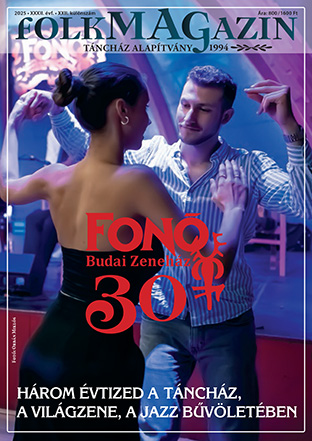

The Fonó: Buda’s House of Music – celebrates 30 years and three decades of dance house, world music and jazz
The 2025 folkMAGazin Special Issue presents some of the people who have worked with the Fonó over the past 30 years.
Page 3 Dear Friends of the Fonó:
Statement by director of the Fonó – Horváth László
"…The Fonó isn’t just a concert space, record label and publisher – it is also a kind of nest, a stable/a barn, and a home for many productions, musicians, and artists. A living and active workshop for traditions, folk music and jazz – and now for the last couple years also the rehearsal space for the Fitos Dezső Folk Dance Company….
We thank: the Fonó’s founder and his partners for their bravery; our sponsors for their ongoing support; and our audiences for their loyalty….May the next decade be just as rich and inspired as the ones before!”
Page 3 Inset: 2025 list of Fonó Awards and special honors
Page 4-7 – Ten Fonó records – by Török Ferenc: Of the several hundred recordings released on the Fonó label over 30 years, here are Török Ferenc’s own "subjective recommendations….Fonó doesn’t specialize in mainstream music they focus on Hungarian folk, world music, jazz and ethno jazz…these are the records [he] keeps returning to, always finding new surprises within the layers…while noting that: all 10 of them are available on Spotify” [See record titles on article in Hungarian]
Page 8-9 Herczku Ágnes and Nikola Parov – interview by Török Ferenc. Hungarian folk singer Herczku Ágnes and multi-instrumentalist, arranger, producer Nikola Parov (originally from Bulgaria) have been working both seperately and together for many years now to produce good music.
Page 10-11 Dresch Mihály – Hungary’s extraordinary jazz musician (b. July 1955) – fellow musicians Borbély Mihály, Fekete Kovács Kornél, Lukács Miklós, Tóth Dániel and producer Horváth László – contribute a few words celebrating Dresch – "a humble genius" – on his 70th birthday in July 2025.
Page 11 List of Dresch recordings
Page 12, 13, 14 Agócs Gergely – interview by Jávorszky Béla Szilárd. Agócs is a musician, singer and ethnomusicologist; a Hungarian originally from Southern Slovakia and an expert on traditional music of his native region, though his interest and research have expanded as far east as Dagestan (for example). He is the leader of the Fonó Zenekar, a band that brings together musicians and singers that move amongst several other bands and genres. Fonó Zenekar was founded in 1997 and has released an impressive number of CDs on, of course, the Fonó label.
Page 15, 16 ,17 Lukács József Lujó – Fonó’s founder, owner – interview by Jávorszky Béla Szilárd
"The directors and the people who go to the Fonó have made it what it is today".
Originally a successful and well-functioning medical instruments company contributed to the opening and funding of the Fonó and it’s projects. Here we read about the dilemmas of keeping an institution such as the Fonó going over the years and where the money comes from that keeps it afloat today. The Fonó survives nowadays partially on government funding through grants that support specific events, projects, series of events, etc. – however such grants cannot be applied to overhead and day to day running costs…
Page 18, 19 Mezei Péter and the Fonó’s record shop – interview by Jávorszky Béla Szilárd. Mezei Péter has been selling records in Hungary since 1982 when he opened Hungary’s third private record store selling jazz records. When they began planning to establish the Fonó, Péter was invited to join their group preparing to open the venue and to manage the in-house record store. He’s been there ever since, always selling the Fonó Records releases and other quality recordings that fit the Fonó profile. Fluctuations and changes in the recording industry have of course affected his record business as well. He remains a stable member of the Fonó framework.
Page 20, 21 Ifj. Csoóri Sándor and Csoóri Sándor Sündi – interview by Javorszky Béla Szilárd. The name Csoóri in these circles doesn’t need any introduction – 3 generations suppporting Hungarian folk culture and the dance house movement. Musician Ifj. Csoóri Sándor has two sons: Sándor Sündi and Bendegúz. The whole family plays Transylvanian music and more. Their motto here: "This culture can be passed on, it is teachable and learnable”. The Csoóri family has always had a presence at the Fonó. As it turns out, a song written by Csoóri Sanyi was a major inspiration for Lukács József Lujó in establishing the Fonó.
Page 22, 23 Fonó label releases – Hungarian music expert and historian Jávorszky Béla Szilárd. Over 400 recordings have been released by the Fonó over 30 years. Reminding us of some of the best ones, he names a few of the artists: Parno Graszt, Csík Band, Lajkó Félix, Ghymes, Boban Markovics, Palya Bea, Balogh Kálmán, Dresch Mihály, Szabados György, Borbély Mihály, and so on. A good number of Fonó’s recordings have made it onto international lists of top world music recordings.
Page 24 Lakatos Róbert by Tóth Dániel and Rácz Mihály. Lakatos Róbert is a conservatory trained violist from Slovakia. He is at home in both classical and folk music, he can bring Bartók to life. He also plays his own compositions. His arrangements of folk music become intimate and independent entities. Lakatos Robért says: "…for me, the Fonó is a cult place. Many success stories have started out here. In today’s commerical world, it is difficult to run an institution where quality comes first."
Page 25 Berecz István – by Varga Veronika. Berecz István is an award winning folk dancer, singer, perfomer, choreographer and the Fonó’s artistic director, who also happens to hold a degree in law. He is the type of person who seems to put his whole energy and good cheer into whatever he does. On the future of the Fonó he says that he would like to organize more and more events presenting authentic, unarranged folk music and dance, where the younger generation can be inspired by master musicians and dancers from the village, and city folks can experience people that have grown up in a music and dance tradition…"
Page 26, 27 Kuczera Barbara by Küttel Dávid. Founder and mentor of the Fonó’s popular ’teen dance houses’, Barbara is dedicated to providing a forum for young musicians to learn to play music for dancing in a live situation. She is a professionally trained and experienced folk dancer and musician (lead fiddler), also a trained teacher in both areas. The teen dance houses focus on practice and experience for young dance house musicians – while providing music for dancing. The Fonó has provided every opportunity and all the technical conditions necessary to make that happen.
Page 28, 29 Dancers, choreographers Fitos Dezső and Kocsis Enikő – interview by Küttel Dávid. Today they are the directors of the Fitos Dezső Tarsulat – a small folk dance company representing contemporary trends in Hungarian folk dance performance – their rehearsal space and headquarters is at the Fonó. They also lead a children’s folk dance group and dance houses for kids held at the Fonó. As young students of Zsuráfszky Zoltán (in the professional Budapest and Honvéd Ensembles) they assisted with folk dance collection work during the Final Hour Project held at the Fonó from 1997. Today their choreographies reflect some of the traditional dancers and music witnessed during that collection project.
Page 30, 31 Both Miklós – interview by Varga Veronika: Since 2021 musician Both Miklós has been director of the Hungarian Heritage House/Hagyományok Háza (HHH). Here he speaks to the difference between roles of the Fonó (encouraging artists and community) compared with that of the HHH (preserving tradition, archiving, research, methodology) while stressing the importance of the two institutions’ continued collaboration and working toogether. Both Miklós is a musician whose first performance outside of high school was at the Fonó at the end of the 1990s with a band known as Barbaro, he went on to play with Napra, Bóth Miklós Folkside, Palimo Story (world music, folk based Hungarian pop).
Page 32, 33 Küttel Dávid – interview by Varga Veronika. Küttel Dávid started out as a folk dancer. He studied at the Hungarian Academy of Dance, danced in the Bihari Ensemble, etc, then he went on to become a musician. He has worked with Kultúrpart, Etnofon, Kiss Ferenc, Héttorony Festival (all based at the Fonó). Today he works in marketing and sales at the Hungarian Heritage House, while maintaining active contact with the Fonó – what connects him to the Fonó? "band rehearsals, work, holidays, family – it’s a place I go to meet with friends, colleagues – because the space, atmosphere, and the company are all good.”
Page 34, 35 Horváth László, Paár Julianna – interview by Bakai Anna from 2023. The Fonó’s PajtaKult project has searched Hungary for smaller, more informal spaces that could accomodate community and un-amplified music. "Pajta" means barn. They have found over 150 of these spaces and have set up a network for communication between them. Fonó director Horváth László is the project leader, while folk singer, musician, music therapist Paár Julianna is one of the project’s artist/ambassadors.
Page 36 Wine and Violin – an article by Petrovics Gabriella from magyarnemzet.hu. For 15 years now, the Fonó has been organizing events that bring Hungarian violin makers and Hungarian winemakers together for a "salon" where people can come try out handmade instruments and taste the wines. There are parallels between making good wine and good instruments - both rely on craftsmanship and quality, carefully selected basic materials. The project was started by Faragó-Thököly Márton a Canadian-Hungarian who moved to Hungary more than 20 years ago to study with Hungarian and European instrument makers.
Page 37 Tóth Viktor – Tercett – by Barcsik Géza (from Jazzma.hu 2020 October 25) – This is a review of a concert that was held at the Fonó on October 22 in 2020 - it was part of the Fonó’s series known as ’Chamber Thursdays’. Tercett is Tóth Viktor’s trio and the name of his first album. The trio plays Hungarian jazz and experimental music. Tóth Viktor is a composer and master of alto sax and other wind instruments. His music synthesizes style characteristics from classical jazz and folk music of the world.
Page 38 Karavan Familia: Asvin – by Olasz Sándor (riff.hu). Karavan Familia (yes, they really are a family) is one of the Roma groups that has had a regular presence at the Fonó over the years. Printed here is a review of their recording "Asvin" from 2014 (A Fonó release) that celebrated the group’s 10 year anniversary. They invited 10 musician friends to join them on the record – playing music of the Roma culture including Hungarian, Bulgarian, Romanian, Serbian, Albanian, Russian, and Spanish, and Arab tunes.
English summaries by Sue Foy
The 2025 folkMAGazin Special Issue presents some of the people who have worked with the Fonó over the past 30 years.
Page 3 Dear Friends of the Fonó:
Statement by director of the Fonó – Horváth László
"…The Fonó isn’t just a concert space, record label and publisher – it is also a kind of nest, a stable/a barn, and a home for many productions, musicians, and artists. A living and active workshop for traditions, folk music and jazz – and now for the last couple years also the rehearsal space for the Fitos Dezső Folk Dance Company….
We thank: the Fonó’s founder and his partners for their bravery; our sponsors for their ongoing support; and our audiences for their loyalty….May the next decade be just as rich and inspired as the ones before!”
Page 3 Inset: 2025 list of Fonó Awards and special honors
Page 4-7 – Ten Fonó records – by Török Ferenc: Of the several hundred recordings released on the Fonó label over 30 years, here are Török Ferenc’s own "subjective recommendations….Fonó doesn’t specialize in mainstream music they focus on Hungarian folk, world music, jazz and ethno jazz…these are the records [he] keeps returning to, always finding new surprises within the layers…while noting that: all 10 of them are available on Spotify” [See record titles on article in Hungarian]
Page 8-9 Herczku Ágnes and Nikola Parov – interview by Török Ferenc. Hungarian folk singer Herczku Ágnes and multi-instrumentalist, arranger, producer Nikola Parov (originally from Bulgaria) have been working both seperately and together for many years now to produce good music.
Page 10-11 Dresch Mihály – Hungary’s extraordinary jazz musician (b. July 1955) – fellow musicians Borbély Mihály, Fekete Kovács Kornél, Lukács Miklós, Tóth Dániel and producer Horváth László – contribute a few words celebrating Dresch – "a humble genius" – on his 70th birthday in July 2025.
Page 11 List of Dresch recordings
Page 12, 13, 14 Agócs Gergely – interview by Jávorszky Béla Szilárd. Agócs is a musician, singer and ethnomusicologist; a Hungarian originally from Southern Slovakia and an expert on traditional music of his native region, though his interest and research have expanded as far east as Dagestan (for example). He is the leader of the Fonó Zenekar, a band that brings together musicians and singers that move amongst several other bands and genres. Fonó Zenekar was founded in 1997 and has released an impressive number of CDs on, of course, the Fonó label.
Page 15, 16 ,17 Lukács József Lujó – Fonó’s founder, owner – interview by Jávorszky Béla Szilárd
"The directors and the people who go to the Fonó have made it what it is today".
Originally a successful and well-functioning medical instruments company contributed to the opening and funding of the Fonó and it’s projects. Here we read about the dilemmas of keeping an institution such as the Fonó going over the years and where the money comes from that keeps it afloat today. The Fonó survives nowadays partially on government funding through grants that support specific events, projects, series of events, etc. – however such grants cannot be applied to overhead and day to day running costs…
Page 18, 19 Mezei Péter and the Fonó’s record shop – interview by Jávorszky Béla Szilárd. Mezei Péter has been selling records in Hungary since 1982 when he opened Hungary’s third private record store selling jazz records. When they began planning to establish the Fonó, Péter was invited to join their group preparing to open the venue and to manage the in-house record store. He’s been there ever since, always selling the Fonó Records releases and other quality recordings that fit the Fonó profile. Fluctuations and changes in the recording industry have of course affected his record business as well. He remains a stable member of the Fonó framework.
Page 20, 21 Ifj. Csoóri Sándor and Csoóri Sándor Sündi – interview by Javorszky Béla Szilárd. The name Csoóri in these circles doesn’t need any introduction – 3 generations suppporting Hungarian folk culture and the dance house movement. Musician Ifj. Csoóri Sándor has two sons: Sándor Sündi and Bendegúz. The whole family plays Transylvanian music and more. Their motto here: "This culture can be passed on, it is teachable and learnable”. The Csoóri family has always had a presence at the Fonó. As it turns out, a song written by Csoóri Sanyi was a major inspiration for Lukács József Lujó in establishing the Fonó.
Page 22, 23 Fonó label releases – Hungarian music expert and historian Jávorszky Béla Szilárd. Over 400 recordings have been released by the Fonó over 30 years. Reminding us of some of the best ones, he names a few of the artists: Parno Graszt, Csík Band, Lajkó Félix, Ghymes, Boban Markovics, Palya Bea, Balogh Kálmán, Dresch Mihály, Szabados György, Borbély Mihály, and so on. A good number of Fonó’s recordings have made it onto international lists of top world music recordings.
Page 24 Lakatos Róbert by Tóth Dániel and Rácz Mihály. Lakatos Róbert is a conservatory trained violist from Slovakia. He is at home in both classical and folk music, he can bring Bartók to life. He also plays his own compositions. His arrangements of folk music become intimate and independent entities. Lakatos Robért says: "…for me, the Fonó is a cult place. Many success stories have started out here. In today’s commerical world, it is difficult to run an institution where quality comes first."
Page 25 Berecz István – by Varga Veronika. Berecz István is an award winning folk dancer, singer, perfomer, choreographer and the Fonó’s artistic director, who also happens to hold a degree in law. He is the type of person who seems to put his whole energy and good cheer into whatever he does. On the future of the Fonó he says that he would like to organize more and more events presenting authentic, unarranged folk music and dance, where the younger generation can be inspired by master musicians and dancers from the village, and city folks can experience people that have grown up in a music and dance tradition…"
Page 26, 27 Kuczera Barbara by Küttel Dávid. Founder and mentor of the Fonó’s popular ’teen dance houses’, Barbara is dedicated to providing a forum for young musicians to learn to play music for dancing in a live situation. She is a professionally trained and experienced folk dancer and musician (lead fiddler), also a trained teacher in both areas. The teen dance houses focus on practice and experience for young dance house musicians – while providing music for dancing. The Fonó has provided every opportunity and all the technical conditions necessary to make that happen.
Page 28, 29 Dancers, choreographers Fitos Dezső and Kocsis Enikő – interview by Küttel Dávid. Today they are the directors of the Fitos Dezső Tarsulat – a small folk dance company representing contemporary trends in Hungarian folk dance performance – their rehearsal space and headquarters is at the Fonó. They also lead a children’s folk dance group and dance houses for kids held at the Fonó. As young students of Zsuráfszky Zoltán (in the professional Budapest and Honvéd Ensembles) they assisted with folk dance collection work during the Final Hour Project held at the Fonó from 1997. Today their choreographies reflect some of the traditional dancers and music witnessed during that collection project.
Page 30, 31 Both Miklós – interview by Varga Veronika: Since 2021 musician Both Miklós has been director of the Hungarian Heritage House/Hagyományok Háza (HHH). Here he speaks to the difference between roles of the Fonó (encouraging artists and community) compared with that of the HHH (preserving tradition, archiving, research, methodology) while stressing the importance of the two institutions’ continued collaboration and working toogether. Both Miklós is a musician whose first performance outside of high school was at the Fonó at the end of the 1990s with a band known as Barbaro, he went on to play with Napra, Bóth Miklós Folkside, Palimo Story (world music, folk based Hungarian pop).
Page 32, 33 Küttel Dávid – interview by Varga Veronika. Küttel Dávid started out as a folk dancer. He studied at the Hungarian Academy of Dance, danced in the Bihari Ensemble, etc, then he went on to become a musician. He has worked with Kultúrpart, Etnofon, Kiss Ferenc, Héttorony Festival (all based at the Fonó). Today he works in marketing and sales at the Hungarian Heritage House, while maintaining active contact with the Fonó – what connects him to the Fonó? "band rehearsals, work, holidays, family – it’s a place I go to meet with friends, colleagues – because the space, atmosphere, and the company are all good.”
Page 34, 35 Horváth László, Paár Julianna – interview by Bakai Anna from 2023. The Fonó’s PajtaKult project has searched Hungary for smaller, more informal spaces that could accomodate community and un-amplified music. "Pajta" means barn. They have found over 150 of these spaces and have set up a network for communication between them. Fonó director Horváth László is the project leader, while folk singer, musician, music therapist Paár Julianna is one of the project’s artist/ambassadors.
Page 36 Wine and Violin – an article by Petrovics Gabriella from magyarnemzet.hu. For 15 years now, the Fonó has been organizing events that bring Hungarian violin makers and Hungarian winemakers together for a "salon" where people can come try out handmade instruments and taste the wines. There are parallels between making good wine and good instruments - both rely on craftsmanship and quality, carefully selected basic materials. The project was started by Faragó-Thököly Márton a Canadian-Hungarian who moved to Hungary more than 20 years ago to study with Hungarian and European instrument makers.
Page 37 Tóth Viktor – Tercett – by Barcsik Géza (from Jazzma.hu 2020 October 25) – This is a review of a concert that was held at the Fonó on October 22 in 2020 - it was part of the Fonó’s series known as ’Chamber Thursdays’. Tercett is Tóth Viktor’s trio and the name of his first album. The trio plays Hungarian jazz and experimental music. Tóth Viktor is a composer and master of alto sax and other wind instruments. His music synthesizes style characteristics from classical jazz and folk music of the world.
Page 38 Karavan Familia: Asvin – by Olasz Sándor (riff.hu). Karavan Familia (yes, they really are a family) is one of the Roma groups that has had a regular presence at the Fonó over the years. Printed here is a review of their recording "Asvin" from 2014 (A Fonó release) that celebrated the group’s 10 year anniversary. They invited 10 musician friends to join them on the record – playing music of the Roma culture including Hungarian, Bulgarian, Romanian, Serbian, Albanian, Russian, and Spanish, and Arab tunes.
English summaries by Sue Foy