


Articles by Initial Letters
A táncházmozgalom ötvenéves jubileuma tiszteletére
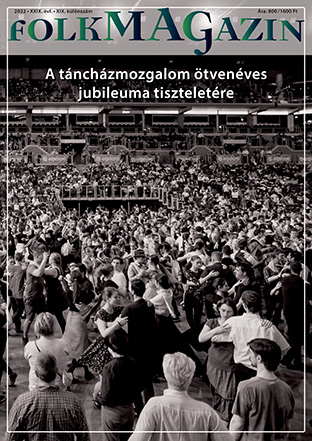

The 2022 special issue of folkMAGazin honors the 50th anniversary of the dance house movement. It includes photographs from "Táncház 50" the travelling photo exhibition curated by Farkas József and three articles on the dance house movement at 50 years by Sebő Ferenc, Berán István and Both Miklós.
Celebrating the 50th Anniversary of the Dance House Movement
Photos are from the "Táncház 50" travelling exhibition – curated by: Farkas József
Articles from three musicians important and deeply involved in Hungary’s dance house movement: a founder of the movement (Sebő Ferenc), a musician who became a main organizer (Berán István), a representative of a younger generation of musicians recently named leader of a key institution (Both Miklós).
Page 4
Sebő Ferenc: Táncház 50
Sebő Ferenc has been named ’National Artist’; he is a Kossuth Award winning singer, guitarist, hurdy-gurdy player, songwriter, ethnomusicologist, architectural engineer, and a key initiator of Hungary’s instrumental folk music revival and dance house movement; he is leader of the Sebő Ensemble.
Published here is his epic summary of the dance house movement. He begins: "Upon this illustrious anniversary, it is worth looking back to the beginning of the 1970s to the period full of excitement, uproar, arguments, and hard work - the result of which became the renaissance of instrumental folk music which made possible a new-seeming form of entertaiment/recreation - the development of the [urban] Táncház and with that, also a renewal in folk dance choreography for stage performance. As one of the participants of this process - today it’s veteran – I believe the story/history includes many important lessons. It is worthwhile to examine the dance house movement in terms of its three important parts: The Music, The Dance, the new form of ’dance house’."
Sebő includes basic information - from personal experience - about the background of the very first ’dance houses’ – meaning social folk dance events - in Budapest in 1972 and how they developed from there. Twice he offers quotes from folk dance researcher Martin György who was a key personality, source of advice, information and inspiration for the movement: "…In our dance houses the type of dances that give more opportunity for self-expression [improvised dances] have become more popular than the chain dances..." Another Martin quote comments on how, prior to the dance house movement… "choreographers of folk dance for stage didn’t think it was so important to use folk tradition as source material for their works. Instead they approached folk dance from an ecletic point of view…"
Sebő states "…this now world-famous Hungarian revival movement of course did not entirely start with us. Already several generations since the 1930s had begun the task…their efforts always contingent on changes in the political situation which deformed good intentions and from time to time interrupted the process…..however, despite the political directions, we - under the spell of the beauty and useability of the traditional material - began to learn and try out the vocabulary of motifs and habits for using the folk music and dance progressions that had formed through use over centuries…..If anything has been a source of healing for our society and culture, it has been the Hungarian revival movement and Dance House…”
Page 14
Berán István: From the example of Szék to a Dance House Academy
Berán István is a Martin György Award winning folk musician. He is the director of the Dance House Association and chief editor and designer of folkMAGazin.
The first few dance houses were closed [social dance] events - those invited were members of Budapest amateur folk dance perfoming ensembles: the Bartók, Bihari, Vadrózsák, Vasas [who knew their folk dance in choreographies, and didn’t normally socially folk dance together]. The first Budapest dance house in 1972 bore the motto of "Táncház - Music and Dance like in Szék". These first táncház events were soon followed by regularly held social folk dance events with live music open to the general public. This more or less sponantaously developing initiative was helped along and made possible by a series of factors…” Berán marks the development of the movement through 5 decades. "The second decade of the dance house movement began with the first National Dance House Festival and Market held in Budapest - which was organized upon the example of a similar event held from 1978 on in the Transylvanian town of Székelyudvárhely….Until the regime change of 1990 and for awhile afterwards, the regularly held dance houses held in recreation centers prospered. In Budapest there were dance houses every night of the week, each of which had a following of sorts according to the band, dance teachers, material taught.…by the end of the 1990s the dance houses became more and more specialized in music and dance material, breaking with the previously more general regional material into music and dances from smaller regions, or even a particular village. This became more and more difficult to follow for those not deeply involved in the movement….With the establishment of the Hungarian Heritage House around the year 2000, the movement’s spontaneous character dissappeared for good - taking on an institutional form, becoming also an atttractive employment /career possibility for many….In 2010 the Hungarian committee for Intellectual Cultural Heritage began the process of submitting the ’dance house method’ to UNESCO, and was eventually added to the offical world wide list of ’good methods for protecting traditional heritage’….The 2012-2016 nationally televised ’PÁVA’ folk talent competitions boosted exposure and public interest. Soon the Hungarian Heritage House began the process of establishing a network of related institutions in outlying areas where Hungarians live. Also at this time the Folk Music Department of the Hungarian Academy of Music was established. …The 50 year anniversary of the first Budapest dance house was held however during the Covid-19 pandemic….
Page 24
Both Miklós: What’s next for the dance house movement?
Both Miklós has recieved the Hungarian Golden Cross of Honour; is a two time winner of the Fongram Award; and a Budai Award winning composer and performer. He founded the Polyphony Project for research on traditional music of Ukraine. Since 2021 he has been Director of the Hungarian Heritage House.
Both Miklós begins by stating a few facts about what the dance house movement has accomplished so far, then formulates questions to guide the future of the movement: In which cultural areas do the results of the last fifty years of the movement appear today? What kind of players move the processes today? What key words motivate the current generation of cultural users? Are the habits of the cultural consumers (today) in agreement with the earlier goals of the dance house movement? He says that, while there aren’t immediate answers to these questions, he believes they must be bravely addressed. He goes on to note that the roles of participants of the movement have become specialized over the past decades and can be named in three groups: researchers, performers, organizers. He says also that it would be worthwhile to rethink the movement’s relationship to science (research). He mentions that there have been changes in the scientific point of view (both in Hungary and abroad) in recent years that need to be considered. He also notices the trend that today some participants would be happy to let go of the scientific (research) side of the movement. Going on, he also mentions that goals for organizers have changed over the years with more emphasis on for example productivity and profit aspects. He makes the point that: a movement gains strength when the collected cultural elements are used often and by many in the creative area too…..". "The deeper and more layered the knowledge of a cultural phenomenon, the greater its potential for creative social use.” Amongst final comments are: the "importance of supporting continued disclosure of existing source materials; the use and definition of the term ’informant’ needs to be rethought;….We must expand our tasks in the study of the movement, while furthering connections with revival movements in other countries…"
Celebrating the 50th Anniversary of the Dance House Movement
Photos are from the "Táncház 50" travelling exhibition – curated by: Farkas József
Articles from three musicians important and deeply involved in Hungary’s dance house movement: a founder of the movement (Sebő Ferenc), a musician who became a main organizer (Berán István), a representative of a younger generation of musicians recently named leader of a key institution (Both Miklós).
Page 4
Sebő Ferenc: Táncház 50
Sebő Ferenc has been named ’National Artist’; he is a Kossuth Award winning singer, guitarist, hurdy-gurdy player, songwriter, ethnomusicologist, architectural engineer, and a key initiator of Hungary’s instrumental folk music revival and dance house movement; he is leader of the Sebő Ensemble.
Published here is his epic summary of the dance house movement. He begins: "Upon this illustrious anniversary, it is worth looking back to the beginning of the 1970s to the period full of excitement, uproar, arguments, and hard work - the result of which became the renaissance of instrumental folk music which made possible a new-seeming form of entertaiment/recreation - the development of the [urban] Táncház and with that, also a renewal in folk dance choreography for stage performance. As one of the participants of this process - today it’s veteran – I believe the story/history includes many important lessons. It is worthwhile to examine the dance house movement in terms of its three important parts: The Music, The Dance, the new form of ’dance house’."
Sebő includes basic information - from personal experience - about the background of the very first ’dance houses’ – meaning social folk dance events - in Budapest in 1972 and how they developed from there. Twice he offers quotes from folk dance researcher Martin György who was a key personality, source of advice, information and inspiration for the movement: "…In our dance houses the type of dances that give more opportunity for self-expression [improvised dances] have become more popular than the chain dances..." Another Martin quote comments on how, prior to the dance house movement… "choreographers of folk dance for stage didn’t think it was so important to use folk tradition as source material for their works. Instead they approached folk dance from an ecletic point of view…"
Sebő states "…this now world-famous Hungarian revival movement of course did not entirely start with us. Already several generations since the 1930s had begun the task…their efforts always contingent on changes in the political situation which deformed good intentions and from time to time interrupted the process…..however, despite the political directions, we - under the spell of the beauty and useability of the traditional material - began to learn and try out the vocabulary of motifs and habits for using the folk music and dance progressions that had formed through use over centuries…..If anything has been a source of healing for our society and culture, it has been the Hungarian revival movement and Dance House…”
Page 14
Berán István: From the example of Szék to a Dance House Academy
Berán István is a Martin György Award winning folk musician. He is the director of the Dance House Association and chief editor and designer of folkMAGazin.
The first few dance houses were closed [social dance] events - those invited were members of Budapest amateur folk dance perfoming ensembles: the Bartók, Bihari, Vadrózsák, Vasas [who knew their folk dance in choreographies, and didn’t normally socially folk dance together]. The first Budapest dance house in 1972 bore the motto of "Táncház - Music and Dance like in Szék". These first táncház events were soon followed by regularly held social folk dance events with live music open to the general public. This more or less sponantaously developing initiative was helped along and made possible by a series of factors…” Berán marks the development of the movement through 5 decades. "The second decade of the dance house movement began with the first National Dance House Festival and Market held in Budapest - which was organized upon the example of a similar event held from 1978 on in the Transylvanian town of Székelyudvárhely….Until the regime change of 1990 and for awhile afterwards, the regularly held dance houses held in recreation centers prospered. In Budapest there were dance houses every night of the week, each of which had a following of sorts according to the band, dance teachers, material taught.…by the end of the 1990s the dance houses became more and more specialized in music and dance material, breaking with the previously more general regional material into music and dances from smaller regions, or even a particular village. This became more and more difficult to follow for those not deeply involved in the movement….With the establishment of the Hungarian Heritage House around the year 2000, the movement’s spontaneous character dissappeared for good - taking on an institutional form, becoming also an atttractive employment /career possibility for many….In 2010 the Hungarian committee for Intellectual Cultural Heritage began the process of submitting the ’dance house method’ to UNESCO, and was eventually added to the offical world wide list of ’good methods for protecting traditional heritage’….The 2012-2016 nationally televised ’PÁVA’ folk talent competitions boosted exposure and public interest. Soon the Hungarian Heritage House began the process of establishing a network of related institutions in outlying areas where Hungarians live. Also at this time the Folk Music Department of the Hungarian Academy of Music was established. …The 50 year anniversary of the first Budapest dance house was held however during the Covid-19 pandemic….
Page 24
Both Miklós: What’s next for the dance house movement?
Both Miklós has recieved the Hungarian Golden Cross of Honour; is a two time winner of the Fongram Award; and a Budai Award winning composer and performer. He founded the Polyphony Project for research on traditional music of Ukraine. Since 2021 he has been Director of the Hungarian Heritage House.
Both Miklós begins by stating a few facts about what the dance house movement has accomplished so far, then formulates questions to guide the future of the movement: In which cultural areas do the results of the last fifty years of the movement appear today? What kind of players move the processes today? What key words motivate the current generation of cultural users? Are the habits of the cultural consumers (today) in agreement with the earlier goals of the dance house movement? He says that, while there aren’t immediate answers to these questions, he believes they must be bravely addressed. He goes on to note that the roles of participants of the movement have become specialized over the past decades and can be named in three groups: researchers, performers, organizers. He says also that it would be worthwhile to rethink the movement’s relationship to science (research). He mentions that there have been changes in the scientific point of view (both in Hungary and abroad) in recent years that need to be considered. He also notices the trend that today some participants would be happy to let go of the scientific (research) side of the movement. Going on, he also mentions that goals for organizers have changed over the years with more emphasis on for example productivity and profit aspects. He makes the point that: a movement gains strength when the collected cultural elements are used often and by many in the creative area too…..". "The deeper and more layered the knowledge of a cultural phenomenon, the greater its potential for creative social use.” Amongst final comments are: the "importance of supporting continued disclosure of existing source materials; the use and definition of the term ’informant’ needs to be rethought;….We must expand our tasks in the study of the movement, while furthering connections with revival movements in other countries…"