


Articles by Initial Letters
Akarjuk-e, hogy éljen a népdal?
Vargyas Lajos művelődéspolitikai írásai
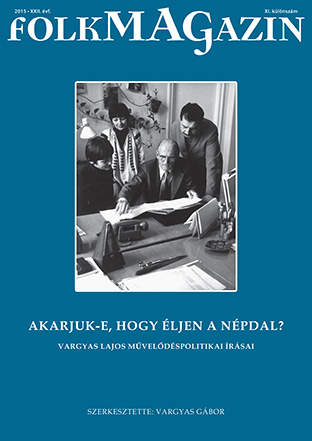

Do we want to keep folk song alive?
Vargyas Lajos’ writings on cultural policy
Editor – Vargyas Gábor (Vargyas Lajos’ son)
Editing staff: Domokos Mária, Paksa Katalin, Rudásné Bajcsay Márta, Szalay Olga, Szőkéné Károlyi Annamária
Hungarian ethnomusicologist Vargyas Lajos (1914-2007) worked at the Folk Music Department of the Museum of Ethnography, he was director of the Folk Music Research Group at the Hungarian Academy of Sciences and then scientific advisor to the Institute of Musicology.
This special issue was prompted by the celebration of Vargyas Lajos’ 100th birthday and a conference held in his honor and memory in September of 2014. The conference was organized by the Hungarian Academy of Sciences’ Institute of Ethnography and Musicology.
This special issue was also prompted by a new series of nationally televised folk talent contests that began around 2014. The new series brought up many of the same or similar questions, arguments and considerations about performing and preserving folklore material - as those printed here. The new series was/is called “Fölszállott a páva”, but is often referred to as simply “Páva”.
This is a collection of writings discussing theoretical issues surrounding folk music, folk dance, folklore, the dance house movement, authentic folk music and scientific research on the subjects.
Page 5 – Introduction by Vargyas Gábor, editor
Page 6-11 - Two articles about doing ethnographical collection work in Hungarian communities outside Hungary’s borders in the 1950s. Controversy arose amongst researchers of the Academy of Sciences over a book from the 1950s on children’s games of Mátyusföld (a region now located in Slovakia) by Bakos Jozsef. Bakos was a Hungarian school teacher from ‘Upper Hungary’ (today in Slovakia), who collected children’s games and songs. His book was edited by ethnographer Ortutay Gyula. When the president of the Hungarian Academy of Sciences was given a copy of the book for his review, the first page he turned to, had a rhyme making fun of Jews. This sparked an official examination of the book by members of the Academy. The review board recommended that the book not be released for distribution.
Page 12-20 – Five articles from 1968-69 on the so-called ‘Breuer argument’.
Heated discussion between Vargyas Lajos and music critic Breuer János arose just before the first “Röpülj páva” Hungarian folk song contest was televised on Hungarian TV in 1969-70. Their discussions focused on issues surrounding the future of folk music, its support and preservation.
Titles of the articles are: “Where has folk song gone?”, “Do we need Hungarian folk song?”, “Folk song and society”, “Folk song’s future”, “Do we want folk song to live on?” They were originally published in the Hungarian journal “Élet és Irodalom”.
The article by Breuer János that set off the controversy begins like this [translated]: “At the mid-level finals of the [televised song talent contest] “Ki mit tud”, an opera singer competed against a Hungarian folk singer. The folk singer was girl from Vas County with a spicy and luscious voice, who without piano accompaniment belted out folk songs with a completely natural frankness and didn’t aspire to any more than what she could do. But she didn’t get as many points from the jury as the competitor that performed a soprano aria from Puccini’s Manon Lescout. Those waiting for me to praise the honorable jury’s decision will be disappointed – actually, I scold them……even the knowledgeable artistic director of the Hungarian State Folk Ensemble Rábai Miklos, voted for the opera….”
Page 21-33 - Seven articles from 1973, ‘74 and 1993 continuing the ‘Breuer argument’ mentioned above - most of the writings are by Vargyas Lajos
Page 34-66 – Twenty-two articles mainly from February to May 1981 on the so-called ‘Páva Argument’ -that is, theoretical questions surrounding how to perform folk song, music, dance and customs. Discussion was sparked by the folk song talent contest known as “Röpulj páva” broadcast on Hungarian radio and television. Most of the articles by a variety of authors were first published in the journal “Élet és Irodalom”. Three of the articles are by Vargyas Lajos.
This section concludes with the article entitled “What direction should the ‘Páva movement’ take?”
Page 67 – 75 Two articles on “other public culture” both by Vargyas Lajos from 1970 and 1971,
entitled: “The folk song in Hungarian society today”, and “The folk song in Hungary”.
Vargyas Lajos’ writings on cultural policy
Editor – Vargyas Gábor (Vargyas Lajos’ son)
Editing staff: Domokos Mária, Paksa Katalin, Rudásné Bajcsay Márta, Szalay Olga, Szőkéné Károlyi Annamária
Hungarian ethnomusicologist Vargyas Lajos (1914-2007) worked at the Folk Music Department of the Museum of Ethnography, he was director of the Folk Music Research Group at the Hungarian Academy of Sciences and then scientific advisor to the Institute of Musicology.
This special issue was prompted by the celebration of Vargyas Lajos’ 100th birthday and a conference held in his honor and memory in September of 2014. The conference was organized by the Hungarian Academy of Sciences’ Institute of Ethnography and Musicology.
This special issue was also prompted by a new series of nationally televised folk talent contests that began around 2014. The new series brought up many of the same or similar questions, arguments and considerations about performing and preserving folklore material - as those printed here. The new series was/is called “Fölszállott a páva”, but is often referred to as simply “Páva”.
This is a collection of writings discussing theoretical issues surrounding folk music, folk dance, folklore, the dance house movement, authentic folk music and scientific research on the subjects.
Page 5 – Introduction by Vargyas Gábor, editor
Page 6-11 - Two articles about doing ethnographical collection work in Hungarian communities outside Hungary’s borders in the 1950s. Controversy arose amongst researchers of the Academy of Sciences over a book from the 1950s on children’s games of Mátyusföld (a region now located in Slovakia) by Bakos Jozsef. Bakos was a Hungarian school teacher from ‘Upper Hungary’ (today in Slovakia), who collected children’s games and songs. His book was edited by ethnographer Ortutay Gyula. When the president of the Hungarian Academy of Sciences was given a copy of the book for his review, the first page he turned to, had a rhyme making fun of Jews. This sparked an official examination of the book by members of the Academy. The review board recommended that the book not be released for distribution.
Page 12-20 – Five articles from 1968-69 on the so-called ‘Breuer argument’.
Heated discussion between Vargyas Lajos and music critic Breuer János arose just before the first “Röpülj páva” Hungarian folk song contest was televised on Hungarian TV in 1969-70. Their discussions focused on issues surrounding the future of folk music, its support and preservation.
Titles of the articles are: “Where has folk song gone?”, “Do we need Hungarian folk song?”, “Folk song and society”, “Folk song’s future”, “Do we want folk song to live on?” They were originally published in the Hungarian journal “Élet és Irodalom”.
The article by Breuer János that set off the controversy begins like this [translated]: “At the mid-level finals of the [televised song talent contest] “Ki mit tud”, an opera singer competed against a Hungarian folk singer. The folk singer was girl from Vas County with a spicy and luscious voice, who without piano accompaniment belted out folk songs with a completely natural frankness and didn’t aspire to any more than what she could do. But she didn’t get as many points from the jury as the competitor that performed a soprano aria from Puccini’s Manon Lescout. Those waiting for me to praise the honorable jury’s decision will be disappointed – actually, I scold them……even the knowledgeable artistic director of the Hungarian State Folk Ensemble Rábai Miklos, voted for the opera….”
Page 21-33 - Seven articles from 1973, ‘74 and 1993 continuing the ‘Breuer argument’ mentioned above - most of the writings are by Vargyas Lajos
Page 34-66 – Twenty-two articles mainly from February to May 1981 on the so-called ‘Páva Argument’ -that is, theoretical questions surrounding how to perform folk song, music, dance and customs. Discussion was sparked by the folk song talent contest known as “Röpulj páva” broadcast on Hungarian radio and television. Most of the articles by a variety of authors were first published in the journal “Élet és Irodalom”. Three of the articles are by Vargyas Lajos.
This section concludes with the article entitled “What direction should the ‘Páva movement’ take?”
Page 67 – 75 Two articles on “other public culture” both by Vargyas Lajos from 1970 and 1971,
entitled: “The folk song in Hungarian society today”, and “The folk song in Hungary”.