


Articles by Initial Letters
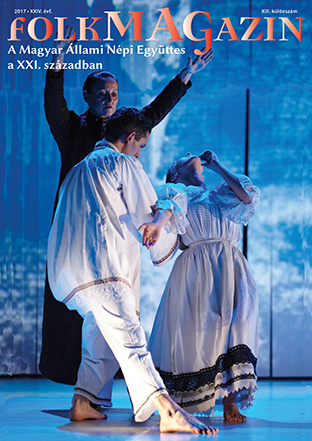
A Magyar Állami Népi Együttes a XXI. században

Hits: 368
Photographs by: Bege Nóra, Boda Gábor, Dely Kornél, Dusa Gábor, Kanyó Béla, Puskel Zsolt, Rácz Gabriella
The text is a philosophical discussion on the State Ensemble’s work over the previous 15 years, focusing on the work and influence of ensemble director and choreographer Mihályi Gábor.
This study is organized under the following headings:
(translations of selected excerpts are provided here)
Page 2 Title page – with opening remarks by the Hungarian State Folk Ensemble’s artistic director Pál István Szalonna
Page 3 - Philosophical introduction
"…in considering the recent past of the Hungarian State Folk Ensemble we search for keys to the deeper layers of the artistic practices and work of choreographer Mihályi Gábor.
…aesthetic formation of imitative movement inspired by tradition - folk dance… as an energetic bodily activity would remain indefinable without back-up from phenomenology and hermeneutics..." (Page 4)
Page 8 - Preliminary notes, hypothetical statements
"…In my experience, since 2000…under Mihályi Gábor’s artistic direction, the State Folk Ensemble instead of focusing on a motionless static past (based on the folk dance documented by the researchers), focuses on its own existing present - thus on the memories within that, and on awaited horizens - …over the last fifteen years the ensemble has searched and is searching for tradition…." (Page 8,9,10)
"…many of the performances have been collaborative works with other choreographers…nevertheless when we look back over the variety and richness of the ensemble’s last fifteen years of activity - it can be seen as one process. Mihályi Gábor’s name is the emblematic and creative name I shall use as coordinator of all the group work and leader of the ensemble…" (Page 15)
Page 16 - The fate of tradition, or its fatelessness
"…the present question becomes: what does tradition mean in our actual world? How can we make the summonable, danceable past our own, and organically build upon that in the present?…"(Page 17)
"…the [State Ensemble’s] repertoire is made up of neither authentic nor dramatic performances, [Mihályi] allows for dance (yes, folk dance ) to freely stand out with its unbridled emotional content as the embodiment of reality…" (Page 20)
Page 21 - Unmarked presence
"The State Folk Ensemble is professionally related to the past, they build on folk dance material documented by the researchers…" (Page 21)
Page 24 - The body of folk dance, or the body’s folk dance
"…Mihályi Gábor’s choreographic world is comparable to that of Merce Cunningham, who while discovering pure dance also ventured close to the source…" (Page 27)
Page 28 – In summary
"…in Mihályi Gábor’s choreographic world, folk dance has become one of the definitive forms of contemporary dance, in such a way that neither its historical embededness nor its community nature has been lost in the meantime." (Page 30)
Page 31 - Endnotes – list of works and authors quoted, referred to.
Hegedűs Sándor (born 1951) studied Hungarian language and literature, history, aesthetics and philosophy at the universities in Szeged and Budapest. He taught dance theory at the Hungarian Academy of Dance, is an award-winning dance writer and critic, was editor of the dance journal "Zene-Zene-Tánc" and has been a curator for the Hungarian National Cultural Fund and the Hungarian Ministry of Human Resources.
The text is a philosophical discussion on the State Ensemble’s work over the previous 15 years, focusing on the work and influence of ensemble director and choreographer Mihályi Gábor.
This study is organized under the following headings:
(translations of selected excerpts are provided here)
Page 2 Title page – with opening remarks by the Hungarian State Folk Ensemble’s artistic director Pál István Szalonna
Page 3 - Philosophical introduction
"…in considering the recent past of the Hungarian State Folk Ensemble we search for keys to the deeper layers of the artistic practices and work of choreographer Mihályi Gábor.
…aesthetic formation of imitative movement inspired by tradition - folk dance… as an energetic bodily activity would remain indefinable without back-up from phenomenology and hermeneutics..." (Page 4)
Page 8 - Preliminary notes, hypothetical statements
"…In my experience, since 2000…under Mihályi Gábor’s artistic direction, the State Folk Ensemble instead of focusing on a motionless static past (based on the folk dance documented by the researchers), focuses on its own existing present - thus on the memories within that, and on awaited horizens - …over the last fifteen years the ensemble has searched and is searching for tradition…." (Page 8,9,10)
"…many of the performances have been collaborative works with other choreographers…nevertheless when we look back over the variety and richness of the ensemble’s last fifteen years of activity - it can be seen as one process. Mihályi Gábor’s name is the emblematic and creative name I shall use as coordinator of all the group work and leader of the ensemble…" (Page 15)
Page 16 - The fate of tradition, or its fatelessness
"…the present question becomes: what does tradition mean in our actual world? How can we make the summonable, danceable past our own, and organically build upon that in the present?…"(Page 17)
"…the [State Ensemble’s] repertoire is made up of neither authentic nor dramatic performances, [Mihályi] allows for dance (yes, folk dance ) to freely stand out with its unbridled emotional content as the embodiment of reality…" (Page 20)
Page 21 - Unmarked presence
"The State Folk Ensemble is professionally related to the past, they build on folk dance material documented by the researchers…" (Page 21)
Page 24 - The body of folk dance, or the body’s folk dance
"…Mihályi Gábor’s choreographic world is comparable to that of Merce Cunningham, who while discovering pure dance also ventured close to the source…" (Page 27)
Page 28 – In summary
"…in Mihályi Gábor’s choreographic world, folk dance has become one of the definitive forms of contemporary dance, in such a way that neither its historical embededness nor its community nature has been lost in the meantime." (Page 30)
Page 31 - Endnotes – list of works and authors quoted, referred to.
Hegedűs Sándor (born 1951) studied Hungarian language and literature, history, aesthetics and philosophy at the universities in Szeged and Budapest. He taught dance theory at the Hungarian Academy of Dance, is an award-winning dance writer and critic, was editor of the dance journal "Zene-Zene-Tánc" and has been a curator for the Hungarian National Cultural Fund and the Hungarian Ministry of Human Resources.